Explain the Advantages of Blending Different Metal Powders.
OR It may also be defined as material processing technique used to consolidate particulate matter ie. The Preferred Metal-Forming Solution PickPM.

Powder Blending An Overview Sciencedirect Topics
To get desired physical and mechanical properties.

. Powder metallurgy is the manufacturing science of producing solid parts of desired geometry and material from powders. Blending powders is one of the oldest unit operations in the solid handling industries. Any material can convert into powder.
MEM_688 HomeWork 6 Submitted by Showmik Azam 111 Explain the advantages of blending different metal powders. A Powders can be mixed to obtain special physical mechanical and chemical characteristics. Powder Metal Materials Blending A Competitive Advantage from Start to Finish.
Complicating matters even more there are special carbon-adhering stages which exist to add alloying strength to the mix. The majority of the industry buys pre-blend powder materials which account for about 70 of the North American powder market. To enhance green strength of parts 4.
Powders both metal andor non- metals. Keystone is one company with the materials engineers and processing expertise to enable complete in-house blending. 2 chemical reduction - reducing metallic oxides by use of reducing agents which combine with the oxygen to free the metals in the form of powders.
Commonly known as powder metallurgy it may also be referred to as powder processing considering that non-metal powders can be involved. Very fine powders are obtained using various techniques. What are some of the disadvantages of the PM methods.
Blending is a process of combining materials but blending is a relatively gentle process compared to mixing. C A uniform blend can impart. Metal in powder form is costlier than in solid form.
Powder metallurgy is also used to make unique materials. What is the difference between open pores and closed pores in metallic powders. Mixing powder of the same chemical composition but different sizes.
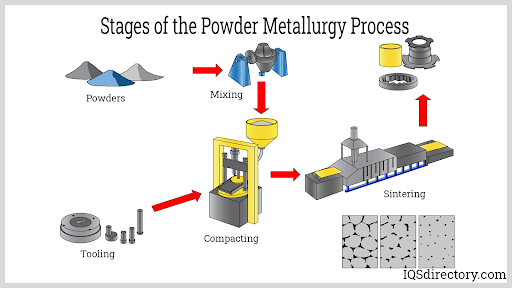
Blending - mixing powders to impact physical and mechanical properties 3. The fine powders are mixed along with a lubricant. Compaction - Blended powders are pressed into various shapes and dies.
There are various processes of producing powder such as atomization. The powder metallurgy process consists of four basic steps. If done on a molten material the resulting spray commonly freezes into powder.
Blending is a process of combining materials but blending is a relatively gentle process compared to mixing. Therefore if it is relevant to phase formation it becomes important to choose the appropriate purity of the powder. All of those different material types flow in different ways.
Minimizes scrap losses by typically using more than 97 of the starting raw material in the finished part. Explain the advantages of blending different metal powders in making PowderMetallurgy products-Metal powders are blended for the following basic reasons-a Powders can be mixed to obtain special physical mechanical and chemical characteristics-b Lubricants and binders can be mixed with metal powders-c A uniform blend can impart. The oxygen content of commercially pure metal powders generally ranges from 005 to 02 wt.
Further expensive dies and equipment needed to adapt this process implies that the process is justified by the unusual properties obtained in the products. The fine powders are mixed along with a lubricant. The blended powder is compacted in a mold or die.
We start the process by using elemental metal powders with each lot certified by our world-renowned. The terms mixing and blending are often used interchangeably but technically they are slightly different. The biggest disadvantage is that HIP is very expensive and therefore used on the most critical components.
This is a first and basic step for producing an object by powder metallurgy process. 100 6 ratings Advantages of blending metal powder- 1. In terms of the phase of material blending is the process of solid-solid mixing or mixing of bulk solids with small.
Many different machines have been designed to handle materials with various bulk solid properties. Minimizes machining by producing parts at or close to final dimensions. 322 Mixing blending of metal powders.
Powder metallurgy offers the following specific advantages. Parts can be produced from high melting point refractory. These powders include many kinds of pure metals master alloys prealloyed powders and refractory compounds.
The blade continuously rotates and mixes the powder. Combining powders of different chemistries. Complicated metallurgical procedures can be avoided as powder metallurgy can easily combine different materials and compact them into a single shape.
In the screening of powders for sizing what is meant by the term mesh count. Even in its granular state powder metal isnt classed as a fully homogenized substance. Powders are compacted into a certain geometry then heated sintered to solidify the.
The powder production methods are 1 atomization - the conversion of molten metal into droplets which solidify into powders. View the full answer. B Lubricants and binders can be mixed with metal powders.
The granules are loaded with carbon and coarse alloying elements. Atomisation is the breakup of a liquid into a fine spray. For many decades powder blending has been used to homogenize bulk materials.
Powder metallurgy is the process of blending fine powdered materials pressing them into a desired shape or form compacting and then heating the compressed material in a controlled atmosphere to bond the material sintering. The above figure a shows the container in which the powder to be mixed is added. On the basis of practical experience gained by engineers with different machines.
Metal powders are blended for the following basic reasons. Powder metallurgy PM is a term covering a wide range of ways in which materials or components are made from metal powdersPM processes can avoid or greatly reduce the need to use metal removal processes thereby drastically reducing yield losses in manufacture and often resulting in lower costs. Name some of the reasons for the commercial importance of powder metallurgy technology.
Advantages of the Powder Metallurgy Process. And 3 electrolysis - use of an electrolytic cell to deposit particles of the metal onto the cathode in the. Definition of Powder Metallurgy Powder metallurgy may defined as the art and science of producing metal powders and utilizing them to make serviceable objects.
There are many ways to atomise metal 8 but for the modern manufacturing methods discussed here the only processes widely used are water and gas atomisation. 2To improve flow characteristics of powder particles reducing friction between particles and dies. Provides materials which may be heat treated for increased strength or increased wear resistance.
MEM_688 HomeWork 6 Submitted by Showmik Azam 111 Explain the advantages of blending different metal powders. Meaning the bonding and mechanical properties in the metal powder are excellent. The lubricant helps in imparting good fluidity to the powders.
Unusual and unique combinations can make up a single part with the use of a binding material. Unlike other processes powder metallurgy can blend and mix different metals and nonmetals into a product.

Powder Metallurgy Process With Its Advantages And Disadvantages Mech4study
Powder Metallurgy What Is It Processes Parts Metals Used

Processing Of Metal Powders Ppt Download
What Is Powder Metallurgy Process Application Advantages Pdf
No comments for "Explain the Advantages of Blending Different Metal Powders."
Post a Comment